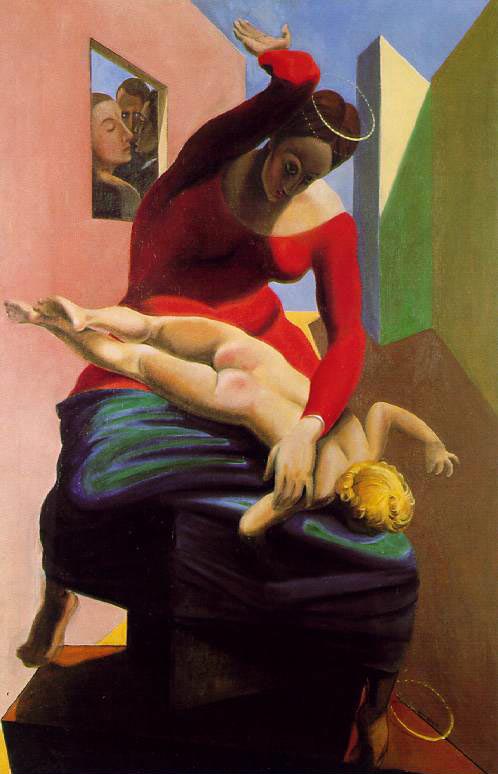
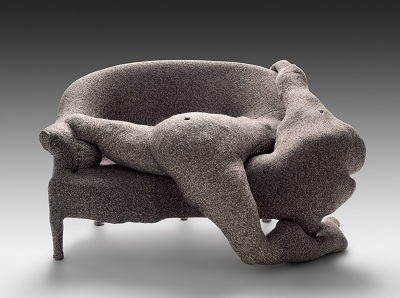
Welcome to the Surreal arts world

If you are interested in arts Visit here:

ENTER
Showing posts with label Giacometti. Show all posts

Tuesday, April 17, 2012

Alberto Giacometti surreal art


Alberto Giacometti's remarkable career traces the shifting enthusiasms of European art before and after the Second World War. As a Surrealist in the 1930s, he devised innovative sculptural forms, sometimes reminiscent of toys and games. And as an Existentialist after the war, he led the way in creating a style that summed up the philosophy's interests in perception, alienation and anxiety.


Related posts:
>>> david-lynchs-surrealism
>>> joseph-beuys
>>> david-lynchs-art-crazy-clown-time
>>> Allan McCollum the Americ...
>>> joseph-beuys-art
>>> surrealism-and-surrealists
>>> abstract-art-and-abstract-expressionism


Although his output extends into painting and drawing, the Swiss-born and Paris-based artist is most famous for his sculpture. And he is perhaps best remembered for his figurative work, which helped make the motif of the suffering human figure a popular symbol of post-war trauma.
by atrstory


Giacometti's work of the 1930s represents probably the most important contribution to Surrealist sculpture.


In an effort to explore themes derived from Freudian psychoanalysis, like sexuality, obsession and trauma, he developed a variety of different sculptural objects. Some were influenced by primitive art, but perhaps most striking were those that resemble games, toys, and architectural models. They almost encourage the viewer to physically interact with them, an idea which was very radical at the time.


Both of the important phases of Giacometti's career yielded innovations that influenced a wide range of artists. His Surrealist sculpture of the 1930s, for instance, influenced Henry Moore, partly inspiring the Surrealism that would be such an important component of Moore's practice throughout his life. It is certainly hard to imagine Moore's own innovative experiments in the 1930s without Giacometti's example. And Giacometti's figurative work was vital in re-establishing the figure as a viable motif in the post-war period, at a time when abstract art dominated. His spindly bronze figures, which appear punctured and fragile, compressed in space, are in many respects visual manifestations of Existentialist thought, emblems of the condition of modern humanity ravaged by doubt.


SOME ALBERTO GIACOMETTI QUOTES

"Let me know how to make only one and I will be able to make a thousand.

"Just the same, if I begin my statue, as they do, with the tip of the nose, then an infinity of time will not be too much before I get to the nostrils."

"When I make my drawings ... the path traced by my pencil on the sheet of paper is, to some extend, analogous to the gesture of a man groping his way in the darkness."


"All the art of the past rises up before me, the art of all ages and all civilizations, everything becomes simultaneous, as if space had replaced time. Memories of works of art blend with affective memories, with my work, with my whole life."


My Own contributory Photo series to ALBERTO GIACOMETTI.
I made this series about a year ago.


Monday, April 16, 2012

Surrealism and surrealists

The Surrealist movement was founded in Paris 1924 by a small group of writers and artists who sought to channel the unconscious as a means to unlock the power of the imagination.
Disdaining rationalism and literary realism, and powerfully influenced by Sigmund Freud, the Surrealists believed the conscious mind repressed the power of the imagination, weighting it down with taboos.


Related posts:
>>> joseph-beuys-art


Influenced also by Karl Marx, they hoped that the psyche had the power to reveal the contradictions in the everyday world and spur on revolution. Their emphasis on the power of the imagination puts them in the tradition of Romanticism, but unlike their forbears, they believed that revelations could be found on the street and in everyday life. The Surrealist impulse to tap the subconscious mind, and their interests in myth and primitivism, went on to shape the Abstract Expressionists, and they remain influential today. 
by artstory


Though the Surrealist movement was officially founded in 1924, the term was first coined in 1917, when Guillaume Apollinaire used it in program notes for the ballet Parade, written byPablo Picasso, Leonide Massine, Jean Cocteau, and Erik Satie. It began as a literary group strongly allied to the Dada movement, and emerged in the wake of the collapse of the group in Paris, when André Breton's eagerness to bring purpose to the group clashed with Tristan Tzara's anti-authoritarianism. Breton - who is occasionally described as the 'Pope' of Surrealism - would go on to be the most important figure in the movement, the impresario whose strong leadership gave it cohesion through its many reincarnations until his death in 1966. 


Feminism and Women Surrealists

The Surrealists have often been depicted as a tightly knit group of men, and their art often envisioned women as wild 'others' to the cultured, rational world. Work by feminist arthistorians has since corrected this impression, not only highlighting the number of women Surrealists who were active in the group, particularly in the 1930s, but also analyzing the gender stereotypes at work in much Surrealist art. Feminist art critics, such as Dawn Ades, Mary Ann Caws, and Whitney Chadwick, have devoted several books and exhibitions to this subject.

While most of the male Surrealists, especially Hans Bellmer, Man Ray, and Salvador Dalí, repeatedly distorted the female form, and depicted women as muses, much in the way that male artists had for centuries, female Surrealists such as Claude Cahun, Unica Zurn, Lee Miller, Leonora Carrington, and Dorothea Tanning, sought to address the problematic adoption of psychoanalysis that often cast women as somehow monstrous. Thus, many female Surrealists experimented with cross-dressing and depicted themselves as animals or mythic creatures.


Artists:


André Breton

Max Ernst

Salvador Dalí

Pablo Picasso


Alberto Giacometti

Joan Miró

Louise Bourgeois


Rene Magritte


Man Ray


Yves Tanguy


Dorothea Tanning


Translate